Red light therapy buying guide: 8 things to check
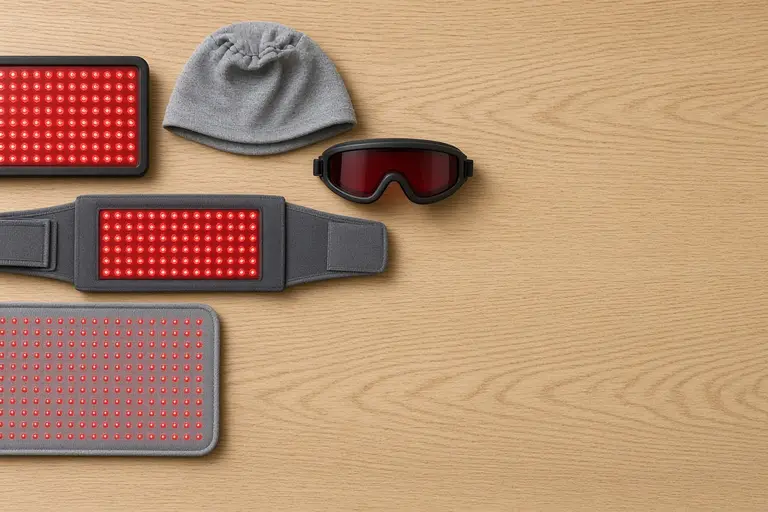
Use this checklist before you buy any at-home red light therapy device.
Talk to your doctor before you start, especially if you are pregnant, take photosensitizing medication, or have a skin or eye condition. See safety and contraindications.
1. Choose the type
Panel, pad, belt, hat, face mask or wand. Match it to the area you want to cover (see the table below). For the face, read mask vs wand.
2. Check the wavelengths
Brands usually list red (about 630–670 nm) and near-infrared (about 810–850 nm). Compare devices that list similar wavelengths.
3. Check the power figure, and how it was measured
Irradiance (mW/cm²) only means something with a measuring distance. Third-party measurements are more trustworthy than marketing figures.
4. Check the coverage area
A bigger panel covers more at once. A pad covers one spot. Make sure the size suits what you want.
5. Look for a timer and auto shut-off
It helps you stick to the maker's recommended session length.
6. Eye protection
Panels and face-height devices should come with goggles. Never look straight into the lights.
7. Warranty, return window and shipping
A long return window lets you try it at home. Check it ships to your country and lists the right electrical safety marks.
8. Talk to your doctor
Especially if you're pregnant, take photosensitizing medication, have a skin or eye condition, or have an implanted device.
FAQ
What should I check before buying a red light therapy device? The device type, the listed wavelengths, a power figure with its measuring distance, coverage area, a timer, eye protection, and the warranty, return window and shipping.
Do I need goggles for red light therapy? Panels and face-height devices should come with eye protection. Wear it, keep your eyes closed, and never look straight into the lights.
Should I talk to a doctor first? Yes, especially if you're pregnant, take photosensitizing medication, have a skin or eye condition, or have an implanted device.
We may earn a commission if you buy through links on this page, at no extra cost to you. It never changes what we say. How we make money.
| Type | Covers | Hands-free? | Typical use | Easy to store? |
|---|---|---|---|---|
| Pad / wrap | One area (knee, shoulder, lower back) | Yes, strapped on | Short sessions while sitting | Yes |
| Belt | Waist or lower back | Yes, wearable | Sessions while moving around | Yes |
| Panel | Large area at a distance | Yes, on a stand or door | Standing or sitting in front | Needs space |
| Hat / cap | Scalp | Yes, wearable | Scalp sessions | Yes |
| Face mask | Whole face | Yes, strapped on | Short face sessions, eyes protected | Yes |
| Handheld wand | Small spots (e.g. around the eyes) | No, you hold it | A few minutes on one area | Yes |
| Brand | Device types we link to | Shop |
|---|---|---|
| ROSSO Red Light | Face masks, eye wand | Check price (affiliate link, opens in a new tab) |
| BioRed | Panels, pads, belts | Check price (affiliate link, opens in a new tab) |
| AWA Red Light | Panels, hats | Check price (affiliate link, opens in a new tab) |