Best red light therapy device for home: how to choose
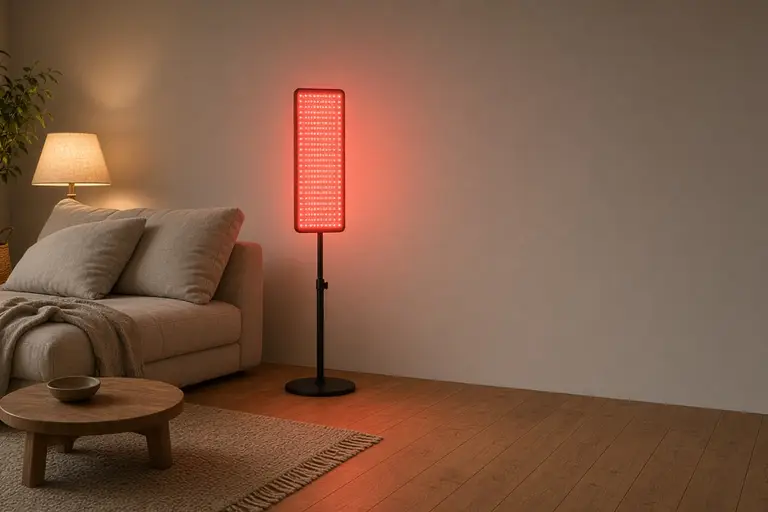
There isn't one best red light therapy device for everyone. The right one depends on which part of the body you want to use it on, how much space you have, and how you'll actually use it day to day. This guide helps you narrow it down, then points you to brands worth comparing.
Talk to your doctor before you start, especially if you are pregnant, take photosensitizing medication, or have a skin or eye condition. See safety and contraindications.
Start with the area you want to cover
- A large area (back, legs, torso): a panel on a stand or door mount. You sit or stand in front of it.
- One joint or spot (knee, shoulder, elbow): a flexible pad or wrap you strap on.
- Waist or lower back while you move around: a belt.
- Scalp: a hat or cap.
- Face: a face mask or a small handheld wand. See best face masks and mask vs wand.
The table below sums up the practical differences.
What to compare before you buy
- Wavelengths listed. Most at-home devices list red (around 630–670 nm) and near-infrared (around 810–850 nm) light. Compare devices that list the same kinds of wavelengths.
- Power, and how it was measured. Brands quote irradiance (mW/cm²) in different ways and at different distances. Prefer figures measured at a stated distance, ideally by a third party.
- Coverage area. Bigger panels cover more at once; pads cover one spot well.
- Timer and auto shut-off. Useful for sticking to the maker's recommended session length.
- Eye protection. Panels usually include goggles. Use them.
- Warranty and return window. A long return window lets you test it at home.
- Certifications and shipping. Check the seller lists the electrical safety marks for your country, and ships to you.
Our take
If you mostly want one area covered, a pad or belt is simpler and usually cheaper. If you want to cover more of the body and have room, a panel is more flexible. Read panel vs pad for the details, and the buying guide for a step-by-step checklist.
For panels, pads and belts, BioRed and AWA are the brands we compare first; ROSSO is listed for face masks only. BioRed lists devices from about $149 to $1,899 USD depending on size. Check current prices and return terms on each brand's site.
FAQ
What is the best red light therapy device for home use? There isn't one best device. Pick by the area you want to cover: a panel for large areas, a pad or wrap for one joint, a belt for the waist or lower back, a cap for the scalp, or a face mask for the face.
What wavelengths should a home device have? Most at-home devices list red light around 630–670 nm and near-infrared around 810–850 nm. Compare devices that list similar wavelengths, and prefer power figures measured at a stated distance.
Is red light therapy safe at home? It may be suitable for many adults when used as the maker directs, but it isn't for everyone. Talk to your doctor first, especially if you're pregnant, photosensitive or have an eye condition, and never look straight into the lights.
We may earn a commission if you buy through links on this page, at no extra cost to you. It never changes what we say. How we make money.
| Type | Covers | Hands-free? | Typical use | Easy to store? |
|---|---|---|---|---|
| Pad / wrap | One area (knee, shoulder, lower back) | Yes, strapped on | Short sessions while sitting | Yes |
| Belt | Waist or lower back | Yes, wearable | Sessions while moving around | Yes |
| Panel | Large area at a distance | Yes, on a stand or door | Standing or sitting in front | Needs space |
| Hat / cap | Scalp | Yes, wearable | Scalp sessions | Yes |
| Face mask | Whole face | Yes, strapped on | Short face sessions, eyes protected | Yes |
| Handheld wand | Small spots (e.g. around the eyes) | No, you hold it | A few minutes on one area | Yes |
| Brand | Device types we link to | Shop |
|---|---|---|
| ROSSO Red Light | Face masks, eye wand | Check price (affiliate link, opens in a new tab) |
| BioRed | Panels, pads, belts | Check price (affiliate link, opens in a new tab) |
| AWA Red Light | Panels, hats | Check price (affiliate link, opens in a new tab) |