Red light therapy panel vs pad
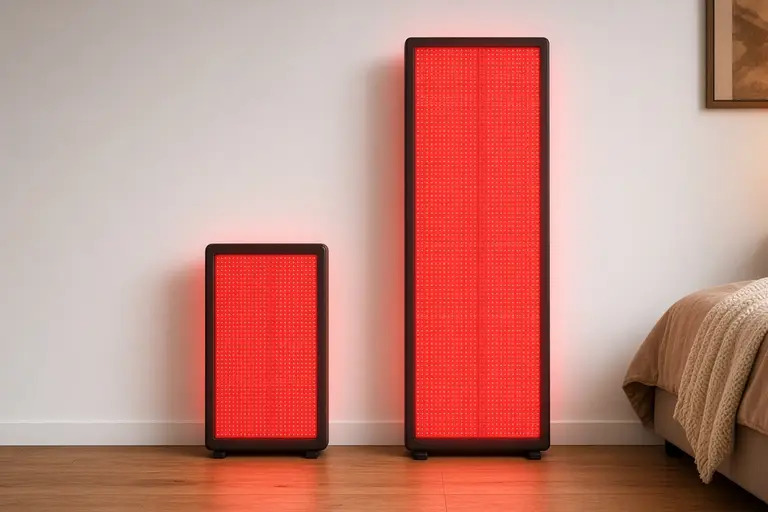
Panels and pads use the same kind of light. The difference is how much of your body they cover and how you use them.
Talk to your doctor before you start, especially if you are pregnant, take photosensitizing medication, or have a skin or eye condition. See safety and contraindications.
Panels: more coverage, more space
A panel is a flat light you place on a stand, door mount or table and sit or stand in front of, usually at a distance the maker specifies. Larger panels can cover your back or legs in one session.
- Good for: larger areas, people who want one device for several areas.
- Watch for: you need floor or wall space, and you should wear the supplied goggles.
Pads: one spot, very simple
A pad or wrap is flexible and straps directly onto one area, such as a knee or shoulder. You can sit and read while it runs.
- Good for: one joint or area, small homes, travel.
- Watch for: it only covers what it touches, so a large area needs a large pad or several sessions.
Quick way to decide
- Want to cover one area? Start with a pad.
- Want to cover several areas or a large area? Look at a panel.
- Want your lower back while moving? See red light belts.
- Only interested in your face? Panels and pads aren't the usual choice; see face masks and mask vs wand.
FAQ
Is a red light panel or pad better? Neither is better overall. A pad straps onto one area and is simple and portable. A panel covers a larger area from a distance but needs space and eye protection.
Which is cheaper, a panel or a pad? Pads and wraps are usually cheaper than panels, which tend to cost more as they get larger.
Can I use a panel for my face? Panels are used at a set distance with goggles on. For the face only, a mask or wand is the more usual choice; see our mask vs wand guide.
We may earn a commission if you buy through links on this page, at no extra cost to you. It never changes what we say. How we make money.
| Panel | Pad / wrap | |
|---|---|---|
| Treatment area | Large (torso, legs) at a set distance | One body part, in contact |
| Setup | Stand, door mount or table | Strap it on |
| Eye protection | Goggles usually supplied; follow the manual | Less glare, but follow the manual |
| Space | Needs floor or wall space | Fits in a drawer |
| Price band | Usually higher | Usually lower |